

Two extra people arrive at six, and the table that seats four politely now has to seat six. A desk chair gets dragged in from the bedroom. Plates slide to the edges to make room for the serving bowl, elbows knock on every pass of the bread basket, and the person on the wall side has to ask twice for everyone to scoot forward before they can stand up. The chair back leaves another gray scuff on the paint. That is the exact moment most people start shopping for an extendable dining table, and it is also the moment they realize they have no idea what size will actually fit.
Seat Four Tonight and Eight on Thanksgiving
Our dining specialists measure small Las Vegas dining rooms and open the tables with you, so you see the leaf, the slides and the extended footprint before you buy. Shop extendable dining tables, dining chairs and complete dining sets with delivery and setup by our own crews.
The reassuring part is that this problem has a well-established solution, and it comes down to arithmetic rather than luck. At Walker Furniture, our team has been sizing dining rooms for Southern Nevada families since 1954, from apartment nooks near the Strip to formal dining rooms in Summerlin and Henderson, so we know how much table a room can really hold. This guide walks through how to measure a small dining room, how each extension mechanism works, which shapes and bases free up floor space, what a table really seats once chairs are pulled out, which materials survive daily meals, how to style a compact dining room, and seven tables from our floor.
Key Takeaways
- Measure twice, for two footprints: An extendable dining table has to fit closed for everyday use and extended for the largest gathering, and the extended number is the one that has to clear 36 inches on every side.
- Twenty-four inches per diner: Allow about 24 inches of table edge per person, with 22 inches as a tight minimum, and apply the rule to both the closed and extended lengths.
- The base decides real capacity: A pedestal or trestle base lets knees and an extra chair slide anywhere along the edge, while four corner legs lock seating positions and waste the corners.
- Match the mechanism to the frequency: A table opened weekly needs smooth metal slides and a stored-in leaf, while a table opened twice a year can live with removable leaves kept in a closet.
Know Your Real Usable Space Before You Shop
Two numbers decide almost everything. Allow roughly 36 inches of clearance from every table edge to a wall or another piece of furniture, and target 42 to 48 inches where people walk behind seated diners. Below 36 inches, a seated person cannot push back far enough to stand without asking someone to move.
The calculation is simple once you have the room dimensions. Measure the room wall to wall in both directions. Subtract 72 inches from each direction, since you need 36 inches on both sides. What is left is the maximum table footprint your room can hold at full extension. A 10 by 12 foot dining room, for example, leaves a maximum of about 48 inches by 72 inches, which is a comfortable six-seat table when open.
Sizing Per Person
Plan on about 24 inches of table edge per diner, and treat 22 inches as the tight minimum you can live with for a holiday meal but not for daily use. Run the math on both configurations:
- Closed length divided by 24 tells you the everyday seat count along the long sides.
- Extended length divided by 24 tells you the holiday seat count.
Add one seat at each end only if the table is at least 36 inches wide and the base allows knees at the end.
- Subtract a seat anywhere a corner leg lands where a person would sit.
This double calculation is where most guides stop short. An extendable dining table has to be sized twice, once for the closed footprint you look at 360 days a year and once for the extended footprint with chairs pulled out. A table that fits beautifully when open may crowd the room every ordinary Tuesday, and that is the version you live with.
Doorways, Walkways and the Light Fixture
Three constraints trip people up after the purchase. A doorway or archway that opens into the dining area needs its full swing clear of the extended table. A walkway that passes through the room to the kitchen needs its own path, separate from the 36 inches behind the chairs. And the pendant or chandelier should be centered on the table’s closed position, since that is where the table sits nearly every day. Centering it on the extended position leaves the fixture visibly off-center all year.
Before you buy, run a ten-minute floor test. Lay painter’s tape on the floor in the exact extended footprint, then add 36 inches of tape on all four sides for chairs and walking. Set your current chairs on the tape lines and walk the room. Living with the tape for a day tells you more than any measurement on paper.
Understand How Each Extension Style Actually Works
Extension mechanisms are not interchangeable, and the differences show up every time you open the table. Here is what each one actually does.
- Butterfly leaf: The tabletop splits and a leaf hinged in the middle unfolds from inside the table. It stores permanently in the table, so nothing has to live in a closet. Typically adds 18 to 20 inches.
- Self-storing leaf: A leaf hides on a rack beneath the tabletop and lifts into place when the top separates. Also stores in the table. Usually adds 12 to 20 inches.
- Removable or drop-in leaves: The top separates and one or more loose leaves drop into the gap. They store separately, which is the trade-off. Each leaf commonly adds 12 to 18 inches.
- Drop-leaf: Hinged sides fold down against the base for storage and lift onto swing-out supports for use. Adds 9 to 15 inches per side and works against a wall.
- Draw-leaf or refectory: Leaves pull straight out from under the main top on either end and rise flush. Nothing to carry, and it can add 20 inches or more.
- Console-to-dining: A narrow console against a wall opens into a full dining table with multiple stored panels. It is the most dramatic space saver and takes the most effort to set up.
Read more:
Counter Height Tables - Pros & Cons
Dining Table Heights: A Guide on How to Choose
Slides, Hardware and Where the Legs Land
The hardware under the table matters more than the finish on top. Wood slides are traditional and quiet, but they stick in dry air and need occasional wax. Metal ball-bearing slides glide smoothly, tolerate frequent use, and are what you want on a table that opens most weekends. In the showroom, open and close the table three times and watch whether the two halves come back together without lifting or shoving.
Apron and leg placement decides whether the extended table is actually usable. When a table opens, the leg positions usually stay put while the tabletop grows, so check where the legs land relative to the new seats. A leg directly under a diner’s knees turns a nominal eight-seat table into a real six-seat table.
Matching the Mechanism to How Often You Open It
- Weekly or more: choose a butterfly or self-storing leaf on metal slides, so opening takes under a minute and nothing gets carried.
- A few times a year: removable leaves are fine, provided you have indoor storage for them.
- Once or twice a year: any mechanism works, and a drop-leaf or console table may be the better call for the other 363 days.
Choose the Shape That Seats More Without Taking Over the Room
Shape changes how many people a room holds, not just how the table looks.
Round tables have no corners to walk around and no assigned seats, so a fifth person can squeeze in without anyone getting the corner. Oval tables extend that same softness into a longer footprint, which is why round-to-oval extendable tables solve the small dining room problem better than nearly any other configuration. Square tables suit compact square rooms and seat four generously. Rectangular tables put the most seats along the long sides, which is the right answer in a narrow room or when the table lives against a wall.
Bases and Legroom
The base is the quiet decider. A single pedestal or a trestle base clears the corners completely, so chairs can slide anywhere along the edge and an extra seat can appear on a holiday. Four corner legs lock seating into fixed positions and block the corners entirely.
That is the corner trap most buying guides never mention. A 60 inch rectangular table with four corner legs sounds like it seats six, but the two end seats often land on a leg, so it seats four comfortably and six only if two people accept a leg between their knees. The same 60 inches on a trestle base genuinely seats six.
Visual Weight in a Small Room
Two tables with identical measurements can make a room feel completely different. Glass tops, slim aprons, light finishes and open bases let the eye travel through the piece, so the room reads larger. Heavy skirts, thick pedestals and dark bulk close a room in.
Counter-height and bar-height tables deserve a mention here too. In an open-plan home where the dining area sits next to a kitchen island, a counter-height table lines up visually with the island and keeps sightlines consistent, which makes the whole space read as one room instead of two crowded ones. The taller footprint also puts diners at eye level with anyone standing in the kitchen.
Seat Four Every Day and Eight for the Holidays
Dimensions turn into seat counts predictably. Use these as your starting points:
- A 36 to 42 inch round table: four people comfortably, five in a squeeze on a pedestal base.
- A 48 inch round table: four to six people, and six only on a pedestal base.
- A 40 to 48 inch square table: four people, one per side.
- A 60 inch rectangle: six people on a trestle base, four on corner legs.
- Add one 12 to 18 inch leaf: two more seats in most configurations.
- Add two leaves: a four-seat table commonly reaches eight.
Chairs Are Half the Problem
Chair choice reclaims more floor space than most people expect. Armless side chairs tuck fully under the apron, so the closed table takes only its own footprint. Chairs with arms often will not slide under at all, which quietly adds four to six inches on every side. Backless stools disappear entirely under a counter-height table.
The wall-side bench trick is worth knowing: put a bench on the side of the table nearest the wall, since a bench slides in flush and does not need pull-out clearance behind it. That single swap can save nearly two feet of walking space in a narrow room.
The mismatch that ruins purchases is storage. A table that opens to seat eight is useless if there is nowhere to keep four extra chairs eleven months a year. Plan for that before you buy: folding chairs in a closet, stackable chairs in a garage, a bench that lives against an entry wall the rest of the year, or chairs that double as desk and bedroom seating.
Size in two modes. Pick the everyday configuration for the people who eat there most nights, and the extended configuration for the largest gathering you realistically host, not for the biggest one you can imagine.
Pick a Finish That Handles Real Meals and Real Guests
Tabletop material decides how the table looks in year five.
- Solid hardwood: The most repairable surface here. Scratches sand out and the top can be refinished. It also moves the most with humidity changes.
- Engineered wood with veneer: Dimensionally stable, which matters on an extendable table where leaves must stay flat, and available in far more finishes. Deep scratches cannot be sanded out.
- Tempered glass: Visually light and completely waterproof, but it shows fingerprints and requires cleaning after every meal.
- Ceramic or sintered stone: Extremely heat and scratch resistant, and it will not stain from wine or citrus. Heavy, and chips at the edges are permanent.
- Marble: Beautiful and cool. It stains from acidic foods unless sealed and resealed on a schedule.
- Mixed materials with metal accents: Metal bases resist wobble and add slim visual lines, though welds and joints are worth inspecting.
Why Seam Alignment Matters More Here
On a fixed table, finish quality is about appearance. On an extendable dining table, it is about the seam. Leaves that do not match the main top in color, grain or sheen announce themselves at every gathering, and the leaf sits right in the middle of the table where everyone looks. A leaf stored in a dark closet also ages differently from a top that gets daily sunlight, so the color gap widens over years rather than closing.
Here is the detail our delivery crews walk through with every customer taking a table with removable leaves in the Las Vegas valley: store the leaves flat and indoors, never in the garage. An attached garage here routinely passes 120 degrees in July while indoor humidity sits in the single digits, and a solid wood leaf left out there will cup, shrink and fade at a completely different rate than the table inside. A flat spot under a bed or on a closet shelf keeps the leaf and the top aging together.
The Showroom Quality Checklist
- Open and close the table three times and feel whether the slides move smoothly or bind.
- Run a hand across the seam with the leaf in place and check that the top is level, with no lip.
- Look down the length of the apron to confirm it lines up rather than stepping at the joint.
- Check the leaf fit for gaps wide enough to catch crumbs.
- Lean on the extended end and watch for tipping or flex.
Make a Compact Dining Room Feel Bigger and Work Harder
Placement comes first. Center the table under the light fixture in its closed position, and decide honestly whether the table floats in the room or lives against a wall. Floating gives every seat equal access and needs clearance on four sides. Pushing toward a wall saves real space and works beautifully with a drop-leaf table or a console table that only becomes a dining table when guests arrive.
Lighting scale follows a simple pair of rules. A pendant or chandelier should be roughly half to two-thirds the width of the table, and it should hang about 30 to 36 inches above the tabletop. Too small reads as an afterthought, and too low blocks sightlines across the table.
Rugs need planning for the extended footprint, not the closed one. The rug should extend at least 24 inches past every table edge so chairs stay on the rug when pulled out. In a small room where a correctly sized rug would cover the whole floor, skipping the rug entirely often looks better than using one that is too small.
A few visual tricks reliably enlarge a compact dining room:
- A mirror on the wall opposite a window doubles the apparent light and depth.
- Vertical storage, such as a narrow hutch or floating shelves, holds serving pieces without eating floor area.
- Light wall colors and a pale ceiling raise the perceived height of the room.
- Slim-profile chairs with open backs let the eye pass through instead of stopping at a solid mass.
Dining rooms that double as homework and remote work space need a daily reset. A table that closes in under a minute gets closed. One that requires carrying a leaf to a closet stays open, and the room stays a workspace.
The Holiday Hosting Reset
- Install the leaf a day early so the top can settle and the seam can be checked in daylight.
- Line up the extra chairs and count them against the actual guest list.
- Walk the traffic path from kitchen to table with a full plate in hand.
- Choose a serving surface off the table, such as a sideboard or a rolling cart, so the table stays for eating.
- Move anything breakable out of the widened walkway before guests arrive.
Extendable Dining Table Types Compared Side by Side
| Extension type | How it extends | Where the leaf lives | Typical added length | One-person operation | Main limitation |
|---|---|---|---|---|---|
| Butterfly leaf | Top splits, folded leaf unfolds from inside | Inside the table | 18 to 20 inches | Easy, under a minute | Adds bulk under the top |
| Self-storing leaf | Leaf lifts from a rack under the top | Under the tabletop | 12 to 20 inches | Easy, minimal lifting | Fewer models available |
| Removable leaf | Top separates, loose leaf drops in | Stored elsewhere in the home | 12 to 18 inches each | Manageable but awkward alone | Leaf can fade or warp apart |
| Drop-leaf | Hinged sides lift onto supports | Attached to the table | 9 to 15 inches per side | Very easy | Legs can land in seat positions |
| Draw-leaf | Leaves pull out from under the main top | Under the main top | 20 inches or more | Easy once the slides are broken in | Heavier hardware, higher price |
| Console-to-dining | Narrow console opens into a full table | Inside the console | 40 inches or more | Slower, sometimes needs two people | Setup time discourages daily use |
For frequent entertaining, a butterfly or self-storing leaf wins because nothing has to be carried; for the tightest floor plans, a drop-leaf or console-to-dining table wins; and for a table that stays extended most of the year, removable leaves are perfectly fine since the storage problem rarely comes up.
Extendable Dining Table Pros and Cons for Small Spaces
An extendable dining table is usually the right answer in a small dining room because it lets you size for daily life instead of for the largest holiday of the year. The trade-offs are real, though, and they are mechanical and logistical rather than aesthetic.
Pros
An everyday footprint that fits
The table stays compact for the two to four people who actually eat there most nights, which keeps walking clearance intact all year.
Holiday capacity without a second table
Adding one or two leaves takes a four-seat table to six or eight, so no folding table has to appear in the living room.
Better long-term value
A table that grows with a household stays useful through new babies, teenagers, roommates and in-laws, which is a longer service life than a fixed four-seater.
Flexibility as the home changes
The same table works in an apartment nook and later in a full dining room, so a move does not force a replacement.
Cons
Moving parts loosen over time
Slides, hinges and alignment pins get play after years of use, and a table that gets opened weekly will need its hardware checked and tightened.
Leaves and chairs need somewhere to live
Removable leaves demand flat indoor storage, and the extra chairs that make an extended table useful have to sit somewhere the other eleven months.
What a Las Vegas Dining Room Does to an Extendable Table
Southern Nevada creates a set of dining table conditions that no national guide accounts for. Indoor relative humidity here sits in the single digits for much of the year, sometimes lower than a museum storage vault, and solid wood responds by giving up moisture and shrinking. On an extendable dining table, that shows up in one specific place: the seam. A leaf that fit flush in December can leave a visible hairline gap by June, and a leaf stored somewhere hotter or drier than the table shrinks faster still. Add valley housing stock, where a huge share of homes have a small kitchen nook plus a separate formal dining room, and a lot of families here are actually solving two rooms with two different table strategies rather than one.
- Expect a slight seasonal seam gap on solid wood tables and check leaf fit each fall before hosting season.
- Store removable leaves flat and indoors, since garages and attics here reach temperatures that warp panels within a single summer.
- Veneer, ceramic and glass tops move far less than solid wood in dry air, which makes them the low-maintenance answer for a table you open often.
- Big west-facing valley windows fade an exposed tabletop faster than a stored leaf, so rotate the table or draw a shade during peak afternoon sun.
- In a two-space home, a compact everyday table in the kitchen nook plus a larger extendable table in the formal room usually beats forcing one table to do both jobs.
- Tile and luxury vinyl floors are the valley norm, so felt chair glides matter more here than carpet pads, both for noise and for scratch protection.
The Best Extendable Dining Tables at Walker Furniture
These seven tables answer different small-dining-room problems: counter-height picks that line up with a kitchen island, a compact round bar table for the tightest corner, complete sets that solve table and chairs in one purchase, and clean-lined tables sized for everyday use. Extension hardware and leaf configuration vary by model, so confirm the leaf details on the product page or with our dining specialists before you buy, since that detail decides which measuring rule from the sections above applies to you. Everything here can be measured and opened in our Las Vegas showroom.
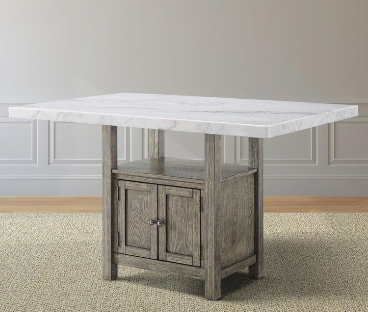
Spring Counter Height Dining Table
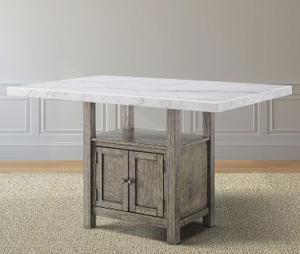
Counter height solves a problem specific to open-plan homes, where a standard-height table sits visibly lower than the kitchen island and makes the whole space read choppy. This table lines up with island height instead, so sightlines stay level and the dining area feels connected to the kitchen rather than tacked on. The taller footprint also pairs with backless stools that tuck completely under the apron, which reclaims walking space in a narrow room. It suits couples and small families who eat most meals within a few steps of the stove.
Top Features
- Counter height design: Lines up with standard kitchen island height so an open-plan dining area reads as one connected space.
- Works with backless stools: Stools slide fully under the table, which removes their footprint from the room between meals.
- Compact everyday scale: Sized for daily meals rather than for a once-a-year crowd, which protects walking clearance.
- Kitchen-adjacent convenience: The taller surface doubles as prep and serving space when the counters fill up.
Bistra Glass Top Round Bar Table with Chrome Base
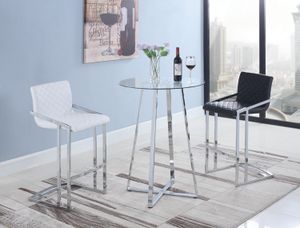
This is the pick for the tightest floor plan in the guide. A round glass top with a slim chrome pedestal gives you every space-saving trait discussed earlier at once: no corners in the traffic path, no assigned seats, a base that clears knees completely, and a transparent surface that lets the eye travel straight through to the floor. In a small apartment dining corner, that combination makes the table nearly disappear when nobody is sitting at it. Wipe it after meals, since glass shows fingerprints and dust more than any other top.
Top Features
- Round glass top: No sharp corners in a tight walkway, and a transparent surface that keeps a small room visually open.
- Chrome pedestal base: Clears the corners entirely so chairs and stools can slide anywhere along the edge.
- Bar height: Pairs with tall stools and works as a standing surface in a compact entertaining space.
- Small footprint, real capacity: A round shape lets an extra person squeeze in without anyone getting a corner.
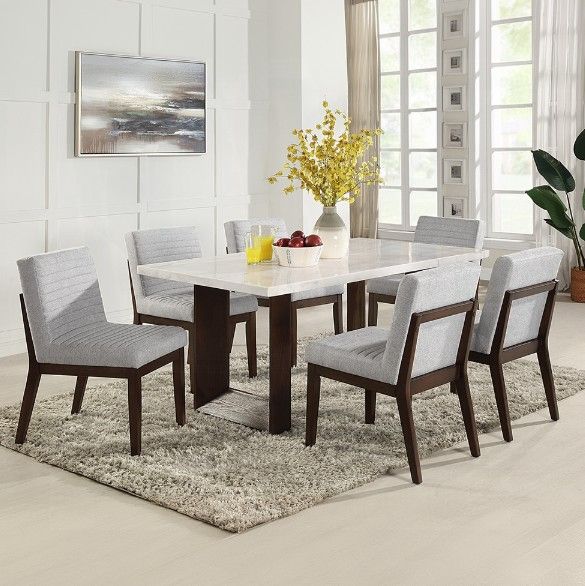
Eddie 5 Piece White Dining Table Set
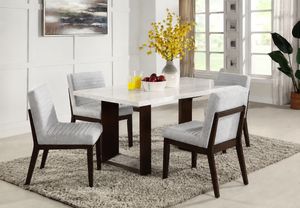
Buying the table and chairs together removes the hardest part of furnishing a small dining room, which is finding chairs that tuck fully under the apron. This five-piece set arrives already matched on scale, height and finish, so the closed footprint is genuinely the footprint. The white top also does something practical in a compact room: light finishes read smaller than their measurements, so the table takes less visual space than a dark one of identical size. It fits a household of four that wants the whole room settled in one delivery.
Top Features
- Table and four chairs matched: Chair height and apron clearance are already coordinated, so the chairs actually tuck in.
- White finish keeps the room open: A light top reads visually smaller than a dark one at the same measurements.
- One-delivery solution: The dining room is furnished in a single purchase instead of a chair hunt after the table arrives.
- Everyday four-seat scale: Sized for the meals a small household eats most nights rather than for the holiday maximum.
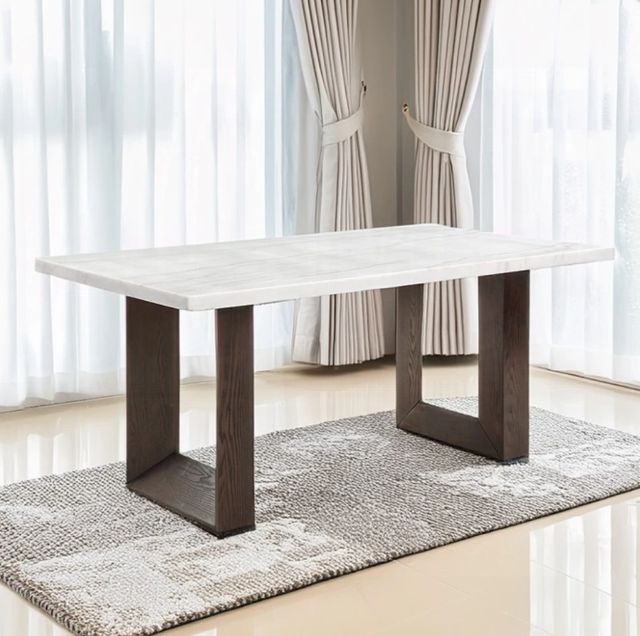
Eddie White Dining Table with Brown Base
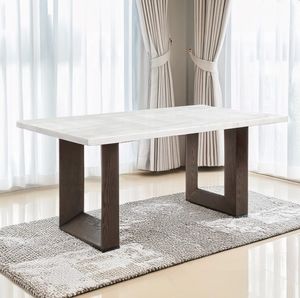
Buy the table alone when you already own chairs you like, or when the chairs need to do double duty as desk and bedroom seating in a small home. The white top over a warm brown base gives a compact dining room two useful things at once: a light surface that keeps the space feeling open, and a wood tone that connects to flooring and cabinetry so the table does not float visually. It also pairs easily with mismatched chairs, since a two-tone table already establishes that the room mixes finishes on purpose.
Top Features
- Sold as a table only: The right choice when your chairs already exist or need to serve more than one room.
- White top with brown base: A light surface keeps the room open while the wood tone ties into floors and cabinets.
- Forgiving with mixed chairs: A two-tone table makes non-matching chairs read as a design decision instead of a compromise.
- Compact dining scale: Proportioned for a small dining room or an open-plan nook rather than a formal hall.
Elysian Counter Dining Table
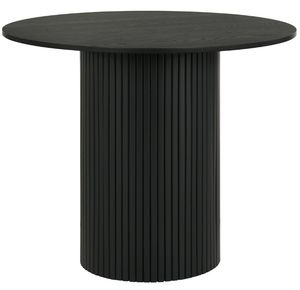
Counter-height dining works particularly well in valley homes where the dining area opens directly onto a great room, because the taller table creates a soft division between spaces without a wall or a screen. This one carries a more refined profile than a basic pub table, so it holds up in a room that guests actually see. The height also makes it comfortable for standing conversation during a party, which turns a small dining area into usable entertaining space instead of a room people walk past. Pair it with counter stools that slide fully under.
Top Features
- Counter height in an open plan: Creates a visual division between dining and living areas without adding a wall.
- Refined profile: Finished enough for a dining space that is visible from the living room and the entry.
- Doubles as party standing space: Guests gather comfortably around a counter-height table, which extends how the room gets used.
- Stool-friendly apron: Designed for counter stools to tuck under, which keeps the closed footprint honest.
Gotti Dining Table
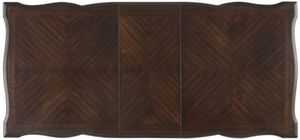
This is the standard-height table in the group for a household that wants a proper dining table without a matched set locked in. Buying the table on its own lets you apply the chair rules from earlier in this guide directly: armless side chairs on the open sides to protect clearance, and a bench on the wall side to reclaim walking space. That flexibility matters most in a narrow dining room where a set of four armchairs would quietly add half a foot on every side. Ask our team about coordinating chairs and benches when you visit.
Top Features
- Standard dining height: Works with the widest range of chairs and benches, which keeps seating options open.
- Sold as a table only: Lets you choose armless chairs or a wall-side bench to fit a narrow room.
- Clean lines for a compact room: A straightforward silhouette reads lighter than a heavily skirted table at the same size.
- Flexible pairing: Suits mixed seating, which is the most practical answer in a small dining space.
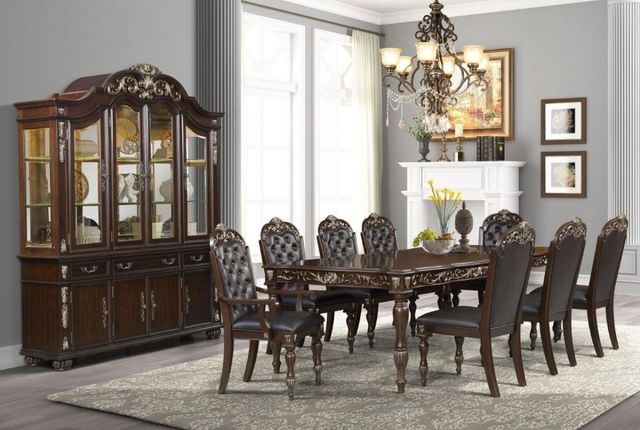
Gotti 9 Piece Dining Table Set
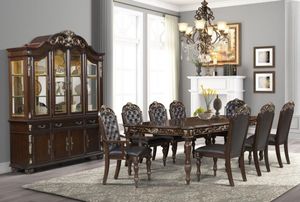
This is the nine-piece configuration of the same design, and it is the entertaining answer in this lineup. Buying the table with a full set of seating solves the storage-aware problem raised earlier, because every chair arrives matched to the table’s height and apron rather than gathered from three rooms on Thanksgiving morning. It suits a larger household, a family that hosts regularly, or a home where the formal dining room is the gathering space. Measure the extended footprint plus 36 inches on all sides before ordering, and our team will confirm the fit with you.
Top Features
- Nine-piece configuration: Table and seating arrive together, so the holiday chair scramble never happens.
- Matched height and clearance: Every chair is sized to the apron, which keeps the closed footprint predictable.
- Built for regular hosting: The right scale for a household that gathers often rather than once a year.
- One coordinated delivery: Table and seating land together and are set up in place by our own crews.
Find the Extendable Dining Table Your Small Room Deserves
Measure for both the closed and the extended footprint, pick the mechanism that matches how often the table will actually open, and let the shape and base type decide how many people really fit. Get those three right and a small dining room can host eight without feeling crowded on an ordinary Tuesday.
See it happen in person. Shop dining tables online at Walker Furniture or visit our Las Vegas showroom, where our dining specialists will open and extend the tables with you, let you feel how the slides move, check the leaf fit across the seam, and measure your room’s numbers against the real footprint. Our own crews handle delivery, assembly and setup, and our service team is here in the valley long after the sale. That is the difference between buying from a family-owned Nevada retailer and buying a flat box with an instruction sheet.
Read more:
Comparing Table Shapes: Is a Round Dining Table Set Right for You?
Best Counter Height Dining Sets for Kitchen Nooks & Breakfast Areas
Frequently Asked Questions about Extendable Dining Tables
Measure the room in both directions, subtract 72 inches from each to reserve 36 inches of clearance per side, and the remaining figure is your maximum extended footprint. In a typical 10 by 12 foot dining room that works out to roughly 48 by 72 inches when open, which comfortably seats six with the table closed to a four-seat size for everyday meals.
Allow at least 36 inches from every table edge to a wall or another piece of furniture, and target 42 to 48 inches where people walk behind seated diners. Below 36 inches a seated person cannot push their chair back far enough to stand without asking the person next to them to move first.
A butterfly leaf is a hinged panel stored inside the table that unfolds to add length in the middle, while a drop leaf is a hinged section of the tabletop itself that folds down against the base when it is not needed. Butterfly leaves add more length and keep the table rectangular, and drop leaves let a table live flat against a wall between meals.
Store removable leaves flat and indoors, ideally under a bed, on a closet shelf, or in a padded leaf bag standing against an interior wall. Garages and attics are the wrong choice, since heat and dry air cause a stored leaf to warp, shrink and fade at a different rate than the tabletop it has to match.
Round extendable tables generally perform better in small rooms because they have no corners in the traffic path and no fixed seat positions, so an extra person can join without anyone taking a corner. Rectangular tables win when the room is narrow or the table lives against a wall, since they place more seats along the long sides.
A four-seat table with two leaves commonly reaches eight, since each 12 to 18 inch leaf typically adds two seats at about 24 inches of table edge per diner. The real number depends on the base, because corner legs can block the end seats and turn a nominal eight-seat table into a comfortable six.
Why Trust Walker Furniture & Mattress?
The trust behind Walker Furniture & Mattress is built on a century-long legacy of craftsmanship and family values. It began in the early 1900s with Isadore Alterwitz’s mattress business in Chicago and evolved into a Nevada institution when the Alterwitz family purchased Walker Furniture in 1973. Today, as a locally owned and family-operated business, the Alterwitz family continues to serve the Las Vegas Valley with four convenient locations, offering a personal touch that national chains simply can't match.
Shopping at Walker means more than just buying furniture; it’s about investing in quality backed by a history of community dedication. Customers rely on their expertise for everything from flexible financing options, including long-term no-interest plans. With professional services like delivery tracking and comprehensive furniture protection, Walker Furniture & Mattress remains the region's most reliable choice for creating a beautiful, comfortable home.