

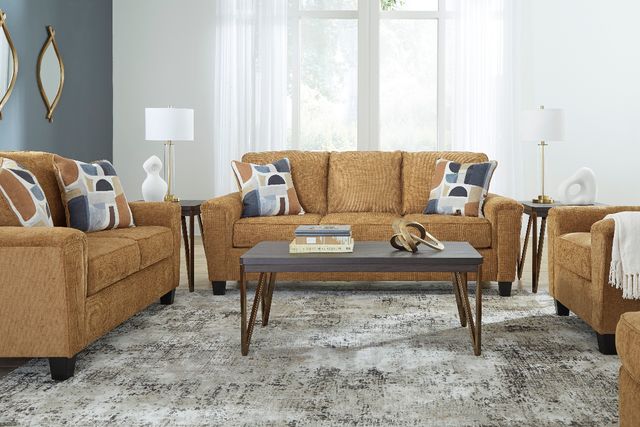
The sofa fit the room on paper. Ninety-two inches along a wall that measured a hundred and ten, with a foot to spare on each side for lamps. Then the delivery crew wheeled it out of the truck, up the elevator of a high-rise off Flamingo, and stopped cold at the unit door, where a 30-inch clear opening met a hard right turn into a hallway with nothing to pivot into. The sofa went back down the elevator and back on the truck. That is the part most people miss about small sofas for small spaces, because the width on the tag was never the real problem. Overall depth, visual bulk, and the route through the front door decide whether a couch ends up in your living room or back at the warehouse.
Find a Compact Sofa That Fits the Room and Still Feels Great
Our team sizes compact sofas to real room measurements, checks your delivery access before the order, and delivers across the Las Vegas Valley. Shop apartment-friendly seating in one place, with financing available.
The reassuring part is that this is a solvable problem, and the solution is mostly arithmetic plus a few smart style choices. Our team at Walker Furniture has sized seating for Summerlin apartments, Henderson townhomes, and Strip-adjacent condos long enough to know exactly where the numbers go wrong. This guide walks through what actually qualifies as a compact sofa, how to measure your room and your delivery path before you order, seven small sofa styles compared on size and real sitting comfort, the comfort features that keep a smaller frame from feeling like a bench, and how to match the right piece to an apartment, condo, studio, or narrow living room.
Key Takeaways
- Width defines the category, depth defines the fit: Loveseats run 52 to 65 inches wide, apartment size sofas 68 to 80 inches, and full-size sofas 84 inches and up. In a tight room, overall depth of 30 to 33 inches matters more than any of those numbers.
- Comfort comes from three variables, not overall size: Seat depth, seat height, and back cushion support decide whether a compact sofa feels good. A well-shaped back can make up for two to four inches of lost seat depth.
- Measure the route, not just the room: Entry door width, hallway turns, and elevator depth stop more sofas than floor space does. Compare your openings against the sofa diagonal depth rather than its width.
- Visual weight is separate from footprint: Exposed legs, a lower back height, tight or track arms, and lighter upholstery make the same footprint read smaller in the room.
The Real Difference Between a Small Sofa and an Uncomfortable One
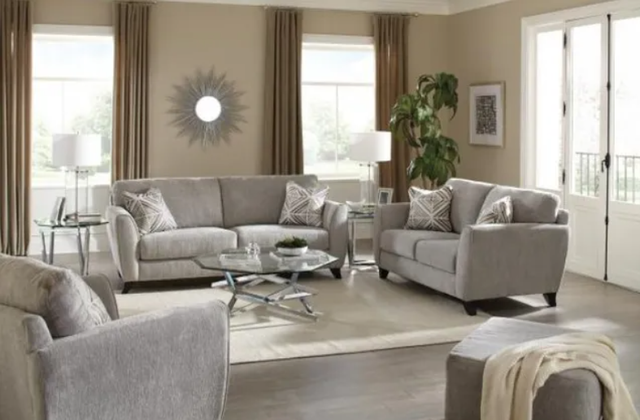
Small is a marketing word until somebody attaches inches to it. Here is where the real category lines fall.
A loveseat generally measures 52 to 65 inches wide. An apartment size sofa generally runs 68 to 80 inches. Anything 84 inches and up is a full-size sofa, no matter how the listing describes it. Those three bands cover almost every couch you will look at, and knowing which one you are shopping saves an hour of scrolling.
Width gets all the attention, though depth is what actually breaks a small room. Standard sofa depth runs 36 to 40 inches front to back. A shallow-depth frame lands around 30 to 33 inches. That difference of six to nine inches comes straight off your walkway, which is why a 78-inch sofa at 39 inches deep can crowd a room worse than an 84-inch sofa at 32 inches deep.
Seat depth is the related number and it is not the same thing. Standard seat depth is 21 to 24 inches. A shallow seat depth sofa sits at 18 to 20 inches. Overall depth includes the back cushion and the frame behind it, so always check both figures on the spec sheet.
Small Does Not Have to Mean Uncomfortable
This is the part competitors skip. Comfort in a compact frame is not decided by overall size at all. It comes down to three things.
- Seat depth: enough to support your thighs without pushing the back cushion out of reach.
- Seat height: usually 17 to 19 inches, which controls how easy the sofa is to get out of.
- Back cushion support: shape, angle, and fill, which is what your spine actually rests against.
Get those three right and a 68-inch sofa can be genuinely more comfortable than a 90-inch one with a flat back and a sagging deck. Get them wrong and no amount of width saves it.
Visual Weight: Why Two Sofas the Same Size Look Different
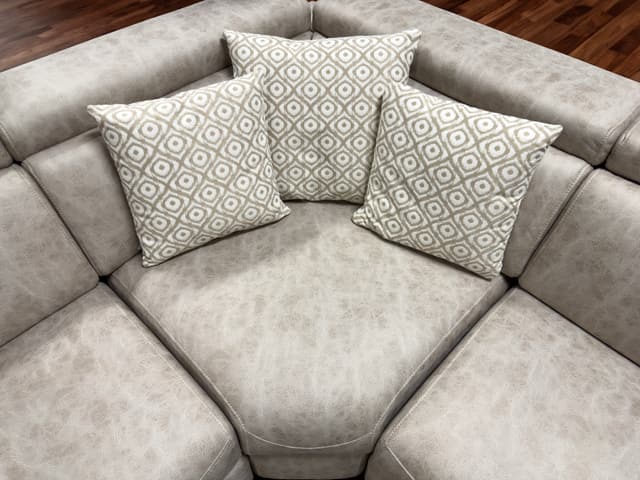
Two frames can occupy identical floor space and read completely differently in a room. The lighter-looking one almost always has exposed legs that show floor underneath, a back that stops around 32 to 34 inches instead of 38, tight or track arms rather than thick rolled ones, and upholstery in a lighter, quieter tone.
None of that changes the footprint by an inch. It changes what your eye reports, and in a small room what your eye reports is what you live with.
So treat style, footprint, and comfort as three separate decisions instead of one. The rest of this guide handles them in that order, starting with the measurements that keep you out of trouble.
Read more:
- 7 Small Sectional Sofas to Maximize Comfort in Limited Spaces
- 4 Leather Loveseat Styles for Your Living Room
Measure Once, Fit Right: Sizing a Sofa to Your Small Living Room
For most small living rooms, the right sofa is 68 to 80 inches wide and no more than 33 to 36 inches deep. A room under 11 feet across usually tops out at a loveseat or a compact apartment sofa, and rooms in the 11 to 13 foot range handle an apartment size sofa comfortably.
That is the short answer. Here is the sequence that produces your exact number.
- Measure the wall the sofa will sit against, at floor level and again at 18 inches up, since baseboards and window sills change the usable length.
- Subtract space for anything that shares that wall, roughly 20 to 24 inches for an end table or a floor lamp on each side you plan to use.
- Keep the sofa to about two thirds of the wall length. A 12-foot wall reads best with a sofa around 8 feet or less, which is why proportion matters as much as fit.
- Leave 30 to 36 inches of clear walkway on any main traffic path, including the route to a balcony slider or a hallway.
- Plan a coffee table gap of 14 to 18 inches between the sofa front and the table edge. Less than 14 and you cannot get in, more than 18 and you cannot reach your drink.
- For a wall-mounted television, allow roughly 1.5 times the screen’s diagonal between the seat back and the screen. A 55-inch television wants about 7 feet, which shallow-depth seating helps you find.
Tape the Footprint Before You Order
Outline the sofa’s width and depth on the floor with painter’s tape, then add a second line 14 to 18 inches out for the coffee table. Live with those rectangles for a full day. Walk the path to the kitchen, open the slider, pull out the dining chairs. A footprint that annoys you on a Tuesday will annoy you for the next decade.
Measure the Delivery Path, Not Just the Room
This is where small-space buyers actually fail, and it has nothing to do with square footage. Write down these numbers before you shop.
- Entry door clear width and height, measured with the door open and any weather strip in place.
- The tightest hallway width and every corner the sofa has to turn.
- Stair landing dimensions and any handrail that reduces the opening.
- Elevator interior depth, width, and door opening, which are three different measurements.
- Any low soffit, light fixture, or ceiling angle on the route.
Then compare those openings against the sofa’s diagonal depth rather than its width. A crew tips a sofa on its side and walks it through, so the number that has to clear the door frame is the diagonal measured from the top of the back to the front edge of the seat deck, not the overall length. That single distinction explains most failed deliveries.
Frames also differ in how forgiving they are. Knock-down frames, modular pieces, and sofas with removable bolt-on legs solve doorway problems that a fully assembled one-piece frame simply cannot. If your access is genuinely tight, shop those first rather than hoping for the best.
When you visit a showroom, bring the wall length, the room depth, your entry door and hallway numbers, and a photo of the room from the doorway. Walker Furniture staff can check a specific frame’s dimensions against your room sketch before the order is placed, which is a much better time to find a problem than delivery morning.
The 7 Best Types of Small Sofas for Small Spaces
There is no single winner among small sofas for small spaces, because a studio, a narrow condo living room, and a den with a guest bed all reward different shapes. These are the seven styles worth your attention, with the honest limitation of each.
1. Apartment Size Sofa
Typically 68 to 80 inches wide and 32 to 36 inches deep, seating two adults comfortably or three in a pinch. It is the closest thing to a full sofa in a reduced footprint, and the savings come from trimmed arms and a shallower back rather than from cutting the seat. Best for a one-bedroom apartment living room or any room 11 to 13 feet across. The limitation is that it still needs a genuine wall run, so it is not a fix for a room with no clear wall.
2. Loveseat
Typically 52 to 65 inches wide and 32 to 38 inches deep, seating two. This is the smallest true two-seater and the most reliable answer for studios, dens, and narrow rooms where anything wider blocks a door. Comfort holds up well because seat depth is usually unchanged from the matching sofa. The honest trade-off is that nobody stretches out full length on a loveseat, so if napping matters, look at the next few styles instead.
3. Small Sectional With Chaise
Typically 78 to 95 inches along the longest side and 58 to 70 inches on the chaise return, seating three. The belief that sectionals never fit small rooms is simply wrong. A compact chaise sectional replaces a sofa plus an ottoman, and because the chaise tucks into a corner, it often uses less open floor than the two pieces it replaces. Check left arm facing versus right arm facing against your actual layout before ordering, because an orientation mistake puts the chaise in your walkway.
4. Sleeper Sofa or Sofa Bed
Twin sleepers run around 60 to 70 inches wide, full sleepers 70 to 80, and queen sleepers 80 to 90. Seating is two to three. The number people forget is the clearance in front, since a queen sleeper needs roughly 80 inches of open floor ahead of the frame to fully open. Modern low-profile and click-clack mechanisms sit far shallower than the old steel bar models, so a current sleeper sofa for small spaces no longer means a bulky frame. The limitation is weight and a firmer seat on some designs.
5. Armless Sofa or Settee
Typically 60 to 76 inches wide and 30 to 34 inches deep, seating two to three. Removing the arms reclaims 6 to 12 inches of width you would otherwise give away to upholstery, which is a real gain when the wall is fixed. An armless sofa for small rooms also slides tight against a wall or floats behind a walkway without visually blocking it. The limitation is lounging, since there is nothing to lean against sideways unless you add a bolster pillow.
6. Wall Hugger Reclining Sofa
Typically 70 to 84 inches wide and 36 to 40 inches deep, seating two to three. A wall hugger mechanism reclines within as little as 4 to 6 inches of wall clearance, compared with 12 to 18 inches on a conventional recliner. That single engineering difference is what makes reclining seating workable in an apartment. The limitation is depth and visual mass, because the mechanism has to live somewhere and these frames are rarely the slimmest option in the room.
7. Modular Sofa
Individual pieces usually run 30 to 40 inches wide each, and you assemble the total. Two advantages matter in a small space. The layout can be reconfigured later when you move or rearrange, and each piece travels through a tight doorway, stairwell, or elevator on its own. The limitation is cost per seat and the need to plan connections, since a poorly matched set of pieces can drift apart with daily use.
Small Space Sofa Styles Compared Side by Side
Find the row that matches your room and read across. Every figure is a typical range across collections rather than a guarantee, so confirm the exact specifications on the product page before you buy.
| Sofa Style | Typical Width | Typical Depth | Seats | Best For | Comfort Strength | Main Limitation |
|---|---|---|---|---|---|---|
| Apartment Size Sofa | 68 to 80 inches | 32 to 36 inches | 2 to 3 | One-bedroom living rooms | Full-sofa feel in less width | Still needs a clear wall run |
| Loveseat | 52 to 65 inches | 32 to 38 inches | 2 | Studios, dens, narrow rooms | Standard seat depth kept intact | No room to lie down |
| Small Sectional With Chaise | 78 to 95 inches | 58 to 70 inch chaise | 3 | Corner layouts and open studios | Built-in leg support | Orientation must match the room |
| Sleeper Sofa | 60 to 90 inches | 36 to 40 inches | 2 to 3 | Guest rooms and studios | Doubles as a real bed | Needs open floor to unfold |
| Armless Sofa or Settee | 60 to 76 inches | 30 to 34 inches | 2 to 3 | Tight nooks and walkways | Slimmest footprint per seat | Nothing to lean on sideways |
| Wall Hugger Reclining Sofa | 70 to 84 inches | 36 to 40 inches | 2 to 3 | Apartments wanting recliners | Reclines in 4 to 6 inches | Deepest style on the list |
| Modular Sofa | 30 to 40 inches per piece | 32 to 38 inches | Varies | Tough delivery access | Reconfigures as needs change | Higher cost per seat |
Upholstery is the other decision that outlasts the purchase, especially on a compact frame where every cushion gets used every day.
| Material | Durability | Cleaning | Best For |
|---|---|---|---|
| Performance fabric | High | Wipes clean, resists stains | Kids, pets, daily heavy use |
| Standard woven fabric | Moderate | Spot clean, varies by code | Adult households, low traffic |
| Leather | Very high | Wipe and condition | Long-term buyers, allergy concerns |
| Faux leather | Moderate | Wipes clean easily | Budget-minded, low-sun rooms |
| Velvet | Moderate to high | Brush and spot clean | Style-forward small living rooms |
Read the first table top to bottom and the pattern shows up fast. Armless designs and loveseats win on smallest footprint, apartment size sofas and small chaise sectionals win on real sitting comfort, and modular pieces win outright when the doorway or elevator is the problem. If you are choosing between two rows, take the shallower depth every time, because floor you can walk on is worth more than three inches of cushion you rarely use.
How a Small Sofa Can Feel as Good as a Full-Size One
Seat depth is the primary comfort lever, and there is a simple fit test. Sit all the way back. Your feet should rest flat on the floor, your back should touch the back cushion, and there should be no large gap behind your knees. If you have to perch forward to reach the floor, the seat is too deep for you, and if your knees hang past the edge, it is too shallow.
Seat height does the other half of the work. Most comfortable sofas land at 17 to 19 inches from floor to the top of the compressed cushion. Lower reads lounge-like and looks less bulky under an 8-foot ceiling, though it asks more of your knees when you stand up. Higher is easier to get out of and better for taller adults.
Cushion Fill, Frames, and Suspension
Cushion fill matters more on a small sofa than a large one, because there is less material to hide a sag.
- High-resiliency foam: holds shape best over time and is the safest choice in a compact cushion.
- Foam wrapped in down or fiber: softer surface with a foam core, needs occasional fluffing.
- Spring-down: coil support inside a down wrap, plush and supportive, usually the priciest.
- All-fiber: soft at first, flattens fastest, and least forgiving in a small seat that gets daily use.
Frame and suspension quality should not drop just because the frame is smaller. Look for kiln-dried hardwood frames, corner-blocked and doweled or screwed joinery rather than staples alone, and either sinuous spring suspension or eight-way hand-tied springs. Webbing appears in lighter-duty designs and is acceptable in an occasional-use den, less so in a studio where the sofa is the only seat in the home.
Back Support Beats Raw Depth
Here is the detail that turns a compact sofa into a comfortable one. Well-shaped back cushions, a slightly reclined back angle, and any real lumbar shaping can fully compensate for two to four inches of lost seat depth. Loose-back designs also feel deeper than tight-back designs at the same measured number, because the cushion compresses and settles around you instead of stopping flat.
Arm style is a comfort and space factor at the same time. Track arms are narrow and straight, and a pair of them can free 6 to 8 inches of width compared with thick rolled arms while still giving you something to rest a pillow against. Sloped arms split the difference. Rolled arms look traditional and cost you the most width. Armless designs give the most seat per inch and the least support for lying down.
One maintenance detail worth planning for from day one: rotate and flip any reversible seat cushions once a month for the first year, then every couple of months after that. On a compact sofa every cushion is a primary seat, so the same two or three cushions absorb all the wear, and most upholstery warranties specifically exclude normal cushion softening and compression from coverage. Rotation is the only thing that keeps the seats even.
Finally, sit on it. Spend several minutes on any frame you are considering, not ten seconds, because a spec sheet cannot tell you where the back cushion lands against your shoulders.
Choosing a compact frame buys back floor space and proportion, and it asks for something in return on seating capacity and lounging room. Weigh both lists against the people who sit down every evening, not the crowd that visits twice a year.
Pros
Reclaimed walkway and floor space
Trimming six to twelve inches of width and several inches of depth returns usable path around the room, which is the difference between walking past the coffee table and turning sideways.
The room reads larger
A lower back, exposed legs, and a shallower profile keep sightlines open, so a small living room feels more open even though the walls have not moved.
Easier delivery and easier moves
Compact and modular frames clear apartment doors, stair landings, and elevators that full-size sofas cannot, and they are far simpler when the lease ends.
Often a lower price point
Less frame, less foam, and less upholstery usually means a lower cost per piece, which leaves budget for better cushion fill or performance fabric.
Better proportion in apartments and condos
A correctly scaled sofa looks intentional in a small room, while an oversized one looks like it was measured for a different house.
Cons
Reduced seating capacity
Two comfortable seats instead of three, and less room to stretch out full length, which matters if you regularly host or nap on the couch.
Some compact frames cut the wrong corners
A few designs reach a smaller size by shortening seat depth or thinning cushion volume, so build quality and comfort features have to be checked more carefully than on a full-size frame.
Read more:
Color, Fabric, and Styling Tricks That Make a Small Sofa Feel Bigger
Styling will not change your measurements, but it changes how big the room reads, and that is worth real effort in a compact space.
Start with the frame itself. Raised legs that show four to six inches of floor beneath the sofa make the piece look like it is floating rather than parked. A back height in the low thirties keeps sightlines running across the room instead of stopping at upholstery. Tight or track arms trim visual bulk. Single-color upholstery calms the whole wall, while a busy large-scale pattern makes the same sofa look like it is advancing into the room.
Color behaves predictably. Light and mid-tone neutrals recede, so a sand, greige, or soft blue sofa visually steps back. Very dark or heavily textured upholstery advances and looks heavier at the same size. That said, a darker sofa is still the right call for a household with pets, toddlers, or a rental deposit riding on the carpet, and performance fabric in a mid-tone is often the best compromise.
The Supporting Pieces That Make or Break the Layout
The sofa is only half the footprint. What you put around it decides whether the room works.
- A nesting or round coffee table, which removes the sharp corners that catch hips in a narrow walkway.
- A slim console behind an armless sofa, adding surface without adding depth to the seating zone.
- Storage ottomans that work as a footrest, extra seating, and a place to hide blankets.
- Armless accent chairs instead of bulky recliners, which keeps the second seating spot from eating the room.
- A rug sized so that at minimum the front legs of the sofa sit on it, so the seating area reads as one intentional zone rather than furniture drifting on bare floor.
Layout depends on room shape. In a roughly square room, floating the sofa 8 to 12 inches off the wall with a slim console behind it actually makes the space feel deeper. In a narrow room, run the sofa along the longest wall and keep everything else off that axis. In an open studio, point a chaise or a sectional return outward and let it draw the line between the living zone and the sleeping zone.
One mistake shows up more than any other. People try to solve a small room by buying several small pieces instead of one correctly scaled sofa, and the result reads cluttered rather than spacious. Three undersized items create three sets of legs, three silhouettes, and three visual interruptions. One right-sized sofa and one chair almost always look calmer and seat more people.
Matching Small Sofas for Small Spaces to Your Exact Room
Skip to the space that matches yours.
- Studio apartment: a loveseat or an armless sofa, because both leave the floor open enough for the bed, and a sleeper adds a guest option without adding a second piece.
- One-bedroom apartment living room: an apartment size sofa, since it delivers the closest thing to full-sofa comfort at a width that respects the wall.
- Condo with an open plan: a small sectional with a chaise, which defines the living zone without a wall doing it.
- Small den or bonus room: a loveseat or a wall hugger reclining sofa, depending on whether the room is for company or for the game.
- Home office guest room: a sleeper sofa or convertible sofa bed, because the room has to change jobs overnight.
- Narrow long living room: an armless sofa or a shallow-depth apartment sofa, both of which protect the walkway that runs the length of the room.
If overnight guests are a regular event rather than a rare one, prioritize a sleeper or a modular group over any fixed frame. A sleeper gives you a real bed on demand, and modular pieces can be pulled apart to open floor space for an air mattress or a portable crib when the whole family visits.
Logistics Worth Settling Before You Order
- In-stock versus special order, since custom upholstery commonly runs several weeks while floor inventory can move immediately.
- Whether the piece arrives in one box or several, which changes both delivery access and setup time.
- Assembly requirements, including bolt-on legs, modular connectors, and sleeper mechanisms that ship partly disassembled.
- Warranty terms on the frame, the cushions, and any reclining or sleeper mechanism, since those three are usually covered for different lengths of time.
Las Vegas adds its own wrinkles. High-rise condo buildings near the Strip often restrict deliveries to a service elevator with a fixed interior depth and a reserved time window. Guard-gated communities in Summerlin and Henderson may require the delivery crew to be listed in advance. HOA rules can limit delivery hours entirely. When a move-in date is fixed and the freight elevator is booked for one afternoon, same-day and next-day local delivery stops being a convenience and becomes the whole plan.
The simplest way to avoid all of it is to bring your room measurements and a photo of the entry to a Walker Furniture showroom, where a specialist can confirm both fit and delivery access before anything is ordered.
The Depth Budget: The Calculation That Decides Which Small Sofa Fits
Most guides tell you to measure the wall, which handles width and ignores the axis that actually causes trouble. Run a depth budget instead. Measure your room from the sofa wall to whatever is opposite it, then spend that number in order from the sofa outward. Sofa overall depth, then the 14 to 18 inch coffee table gap, then the coffee table depth, then the walkway. Whatever is left over is your margin. If the total goes negative, you do not have a layout problem, you have a depth problem, and the fix is a shallower sofa rather than a smaller coffee table.
Here is the budget worked out for a typical 11-foot apartment living room, which is 132 inches wall to wall.
- Standard sofa at 38 inches deep leaves 94 inches.
- Coffee table gap of 16 inches leaves 78 inches.
- Coffee table depth of 20 inches leaves 58 inches.
- Main walkway of 34 inches leaves 24 inches of margin, which a media console at 16 to 18 inches deep consumes almost entirely.
- Swap to a shallow-depth sofa at 32 inches and the margin grows to 30 inches, enough for the console plus real breathing room.
- Swap to an armless design at 30 inches and you gain another two inches, which is often the difference between a slider that opens fully and one that does not.
Read more:
Shop Small Sofas for Small Spaces at Walker Furniture
The seven pieces below cover the range described in the tables above, from a single modular corner chaise for a room that refuses a standard sofa to a convertible sleeper for a guest room that does double duty. Match each one to the measurements you took rather than to a photo, and note where a piece runs larger than the compact category. All are available with same-day or next-day delivery across the Las Vegas Valley, with financing available.
Grassy Right Arm Facing Corner Chaise
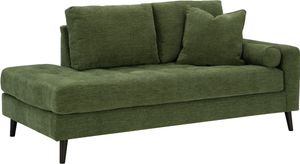
Some rooms simply refuse a standard sofa. An angled entry, a balcony slider, and a fireplace bump-out can leave no clean run of wall long enough to work with. This is a single modular corner chaise piece rather than a full sofa, so you build the footprint the room allows instead of forcing a one-piece frame into it. Start with the chaise in the corner, add pieces later if the layout changes, and carry each section through a tight doorway on its own, which is exactly the advantage modular seating brings to a high-rise delivery.
Top Features
- Single modular piece: Buy the corner chaise on its own and build outward only as far as the room genuinely allows.
- Right arm facing orientation: Confirm the direction against your layout so the chaise lands out of the walkway, not in it.
- Doorway-friendly delivery: Individual sections travel through narrow entries, stairwells, and elevators that one-piece frames cannot clear.
- Corner-first layout: Tucks into a corner and defines a seating zone in an open studio or a condo great room.
Curves Sofa
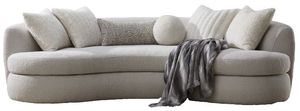
Visual weight was one of the first ideas in this guide, and this is the pick that puts it to work. Soft rounded lines read lighter in a tight room than square boxy arms do, because the eye follows a curve instead of stopping at a hard edge. That makes the same footprint feel less imposing across from a small coffee table. It suits an apartment living room or a condo where the sofa sits in the sightline from the entry and needs to look like a considered choice rather than the largest object in the room.
Top Features
- Rounded silhouette: Curved lines soften the profile so the frame reads lighter than a boxy design of similar size.
- Sightline friendly: A good fit where the sofa is visible from an entry or an open kitchen.
- Style-forward upholstery look: Works as the anchor piece in a contemporary small living room.
- Walkway-conscious shape: Curves avoid the hard corners that catch hips in a narrow path.
Toscana Sofa
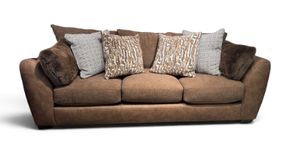
Plenty of small rooms do not need a specialty shape at all. They need one well-proportioned sofa that seats the household, looks settled against the main wall, and leaves the rest of the floor alone. That is the role this one plays. Take your measured wall length, apply the two-thirds proportion rule from earlier in the guide, and confirm the current depth specification against your depth budget before ordering. Our team can pull those numbers for you. It is a straightforward, versatile choice for an apartment or a first home.
Top Features
- Versatile everyday styling: Coordinates easily with existing chairs, rugs, and console pieces.
- Main-wall anchor: Designed to sit along the longest wall in a compact living room.
- Specification check available: Our team confirms current width, depth, and seat depth against your room sketch.
- Practical family use: Suits a household that wants one dependable sofa rather than a multi-piece group.
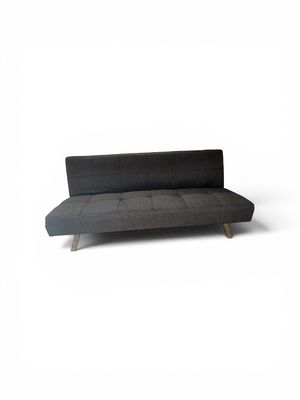
Devon Gray Convertible Sofa Bed
Shop Devon Convertible Sofa Bed
When a studio has to sleep guests, or an office moonlights as a spare bedroom, this is the double-duty answer. It measures 74.5 inches wide, 37 inches deep, and 36 inches high, and the armless design is what keeps that width so efficient, exactly the 6 to 12 inches of savings described earlier. A click-clack mechanism folds the back flat into a sleeping surface for two, with no bulky steel bar frame to pull out. Attached back and seat cushions stay put, chrome legs keep floor visible underneath, and assembly is required on arrival.
Top Features
- 74.5 inches wide and 37 inches deep: A compact overall footprint that still seats two adults comfortably.
- Click-clack sleeper mechanism: The back folds flat to a sleeping surface without a pull-out bar frame or heavy hardware.
- Armless design: No arms means every inch of width goes to seating instead of upholstery.
- Chrome legs and 36-inch height: Exposed legs and a lower profile keep the piece looking light in a studio or office.
- Solid wood and plywood frame: Built for daily conversion duty, with assembly required after delivery.
Geo Sofa
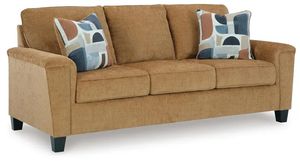
Straight talk on this one. At 89 inches wide, 38 inches deep, and 39 inches high, this is a full-size sofa, not a compact one. It belongs here as the upper limit, the pick for an open-plan apartment or a small-ish living room that measured out with room to spare. Plan on a wall of roughly 8 feet or more before you consider it. What you get for the width is genuine three-seat capacity, narrow track arms that trim visual bulk, tapered accent legs that show floor beneath the frame, warm honey upholstery, and accent pillows included.
Top Features
- 89 inches wide and 38 inches deep: Full-size proportions that need a wall of roughly 8 feet or more.
- Seats three: Real capacity for a household that regularly fills the sofa.
- Track arms: Narrow straight arms save inches compared with thick rolled arms and still support a pillow.
- Tapered accent legs: Visible floor under the frame keeps a large sofa from looking heavy.
- Honey upholstery with accent pillows: A warm mid-tone finish that arrives styled and ready to use.
Lilly Sofa
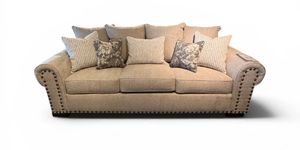
For a den, a bonus room, or a second living area, the goal is usually a sofa that fits the space quietly and gets used every day without becoming the focus. This one is built for that job. Bring your wall measurement and depth budget, then compare them against the current specifications on the product page, since the depth number is what protects your walkway. Our team checks those figures against a room sketch before an order goes in, which keeps a comfortable pick from becoming a tight one.
Top Features
- Secondary-room friendly: A sensible fit for dens, bonus rooms, and upstairs living areas.
- Everyday use focus: Built to be sat on daily rather than reserved for company.
- Measurement support: Our team verifies current width and depth against the room you are furnishing.
- Local delivery: Available with same-day or next-day delivery across the Las Vegas Valley.
Skipper Sofa
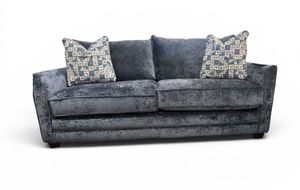
Color is a legitimate small-space tool, and a blue sofa handles it two ways. A mid-tone blue recedes the way any mid-tone neutral does, so it does not advance into the room the way a dark heavy upholstery would, while still giving a compact living room a clear anchor piece. That makes it a strong fit for an apartment or condo with white or light gray walls, where a beige frame would simply disappear. Confirm the current width and depth against your measurements before ordering, and our team will walk that with you.
Top Features
- Mid-tone blue upholstery: A recessive color that anchors the room without visually crowding it.
- Light-wall pairing: Provides needed contrast in apartments and condos with white or light gray walls.
- Single-color upholstery: One solid tone keeps the piece calm in a small room instead of busy.
- Fit verification: Our team confirms dimensions and delivery access before the order is placed.
Small Sofas for Small Spaces That Fit Your Room and Your Comfort
Three numbers carry this whole decision: the width your wall can hold, the overall depth your room can spend, and the openings your delivery path will actually clear. Line those up and pick a frame with real seat depth and honest back support, and a compact sofa gains you floor space without costing you comfort.
When you are ready, shop small sofas for small spaces at Walker Furniture online or in our Las Vegas showrooms, where our large floor lets you sit-test compact frames side by side instead of guessing from a spec sheet. Our staff will check your measurements and your delivery access before the order is written, same-day and next-day delivery covers the valley, and after the sale you reach real local customer service here in Nevada rather than a big-box call center in another time zone. That is what buying from an independent local retailer gets you.
Frequently Asked Questions About Small Sofas for Small Spaces
For most small living rooms, the best sofa is 68 to 80 inches wide with an overall depth of 33 inches or less, which is the apartment size category. Keeping the sofa to roughly two thirds of its wall and leaving 30 to 36 inches of walkway is what makes that size work in practice.
An apartment size sofa is the best all-around couch for small spaces because it delivers close to full-sofa comfort in 68 to 80 inches of width. Loveseats and armless designs win when the room is even tighter, and a compact chaise sectional wins in an open plan that needs a defined seating zone.
Yes, a compact sectional with a chaise works well in a small living room and often uses less open floor than a sofa plus a separate ottoman. The one thing to verify is left arm facing versus right arm facing orientation, because the wrong direction puts the chaise in your main walkway.
A sofa for a small space should have an overall depth of 30 to 33 inches, compared with the 36 to 40 inches typical of standard frames. Seat depth of 18 to 20 inches stays comfortable at that size as long as the back cushions are well shaped and slightly reclined.
A loveseat is usually better in a studio because 52 to 65 inches of width leaves floor open for the bed and the walkway. An apartment size sofa is the better choice only when the studio has a defined living zone with a wall run of at least 9 to 10 feet.
Compare your door and elevator openings against the sofa’s diagonal depth rather than its width, since delivery crews tip a sofa on its side to bring it through. When the numbers are still too tight, choose a modular design, a knock-down frame, or a sofa with removable bolt-on legs.
Why Trust Walker Furniture & Mattress?
The trust behind Walker Furniture & Mattress is built on a century-long legacy of craftsmanship and family values. It began in the early 1900s with Isadore Alterwitz’s mattress business in Chicago and evolved into a Nevada institution when the Alterwitz family purchased Walker Furniture in 1973. Today, as a locally owned and family-operated business, the Alterwitz family continues to serve the Las Vegas Valley with four convenient locations, offering a personal touch that national chains simply can't match.
Shopping at Walker means more than just buying furniture; it’s about investing in quality backed by a history of community dedication. Customers rely on their expertise for everything from flexible financing options, including long-term no-interest plans. With professional services like delivery tracking and comprehensive furniture protection, Walker Furniture & Mattress remains the region's most reliable choice for creating a beautiful, comfortable home.